
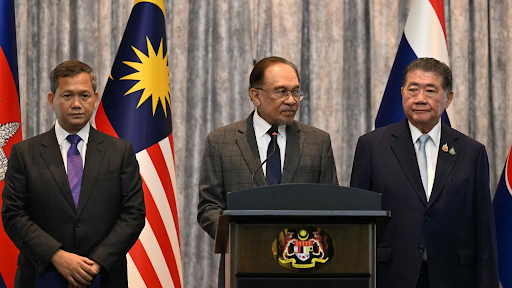
After days of deadly border fighting, Thailand and Cambodia have agreed to an “immediate and unconditional” ceasefire, halting the violence that left 36 people dead and forced nearly 250,000 civilians to flee their homes. The dispute, centered around ancient temples and unclear colonial boundaries, had escalated rapidly with both nations trading blame and artillery shells.
The ceasefire comes after urgent negotiations facilitated by Malaysia, with strong backing from the United States and key Southeast Asian nations. While the truce signals a breakthrough, its effectiveness will depend on continued dialogue and trust between the two countries. Military leaders from both sides are scheduled to meet and begin work on a cross-border peace committee to prevent future flare-ups.
Despite the ceasefire announcement, residents of Samraong in Cambodia reported the sounds of artillery echoing through the region—proof that tensions may not subside overnight. It underscores the delicate nature of the agreement and the long path ahead toward true normalization of border relations.
The current truce is seen as the most substantial move to end recurring conflict since a series of border confrontations that rocked the region between 2008 and 2011. People on both sides of the frontier now watch with hope that this fragile peace will finally hold.