
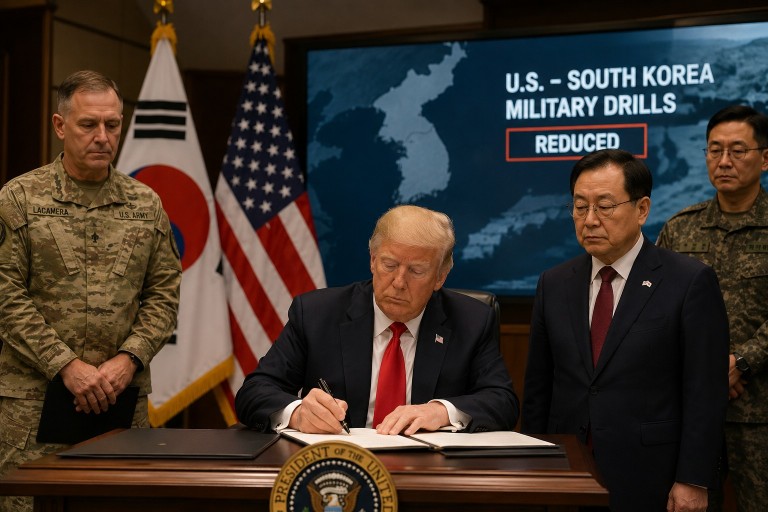
President Donald Trump has announced a significant reduction in joint military exercises with South Korea, citing the high costs and the potential for sending the wrong message to North Korea. The decision, according to Trump, is linked to his favorable relationship with North Korean leader Kim Jong-un. The Ulchi Freedom Shield exercises, which were set to involve 18,000 South Korean troops, U.S. forces, and personnel from several United Nations Command member states, were scheduled to start on Monday and last until August 27.
Although it was too late to completely cancel the exercises this year, Trump directed Defense Secretary Pete Hegseth to considerably decrease U.S. involvement. However, South Korea’s defense ministry indicated that the drills would proceed as initially planned. This decision arises amid warnings from U.S. and South Korean military officials that North Korea is gaining crucial battlefield experience through its military collaboration with Russia in the ongoing conflict in Ukraine. North Korea has been reported to have deployed over 14,000 troops to support Russian forces and supplied artillery ammunition and ballistic missiles.
Military experts note that North Korean forces are acquiring skills in modern warfare technologies, including drones, GPS disruption, cyber operations, and missile systems. The U.S. military has adapted the exercises to tackle these evolving threats, emphasizing that the experience North Korean troops are gaining could bolster Pyongyang’s military capabilities upon their return. In the past, Trump has reduced or suspended major U.S.-South Korean military drills while engaging in diplomacy with Kim, and this recent move has reignited concerns in Seoul regarding the future of the U.S.-South Korea alliance and regional deterrence.
South Korean analysts have expressed worries that scaling back these exercises could undermine military readiness and deterrence, offering limited diplomatic advantages since North Korea has consistently demanded the complete cancellation of such drills. North Korea regards the exercises as rehearsals for an aggressive war and has threatened to retaliate with stronger military measures, having test-fired ballistic missiles in anticipation of the drills.
Despite Trump’s directive, South Korean officials continue to emphasize the critical role of the joint exercises in preparing for the challenges posed by an increasingly capable North Korean military. The decision to reduce U.S. participation remains a contentious issue, highlighting the complex dynamics of diplomacy and military preparedness on the Korean Peninsula.